How to Read AI Reports — From Judgments and Checkpoints to Positive and Negative Factors
The figures in the Key Summary AI Report are calculated using public data, and the AI writes sentences based on those figures. Decisions are made by comparing with type averages, such as those within a 2km radius. Please organize the checkpoints and warning signals to verify, but use this as a reference rather than investment advice.
When comparing complexes, there are too many numbers to examine. AI reports gather market price trends, comparisons of surrounding areas, and local news in one place to help you decide what to check first.
Where can I see it?
On the map , tap the complex badge to open the complex details, then tap AI Report . On PC, it is in the menu at the top of the details, and on mobile, it is in the tab next to Chips and Actual Transaction Prices at the top.
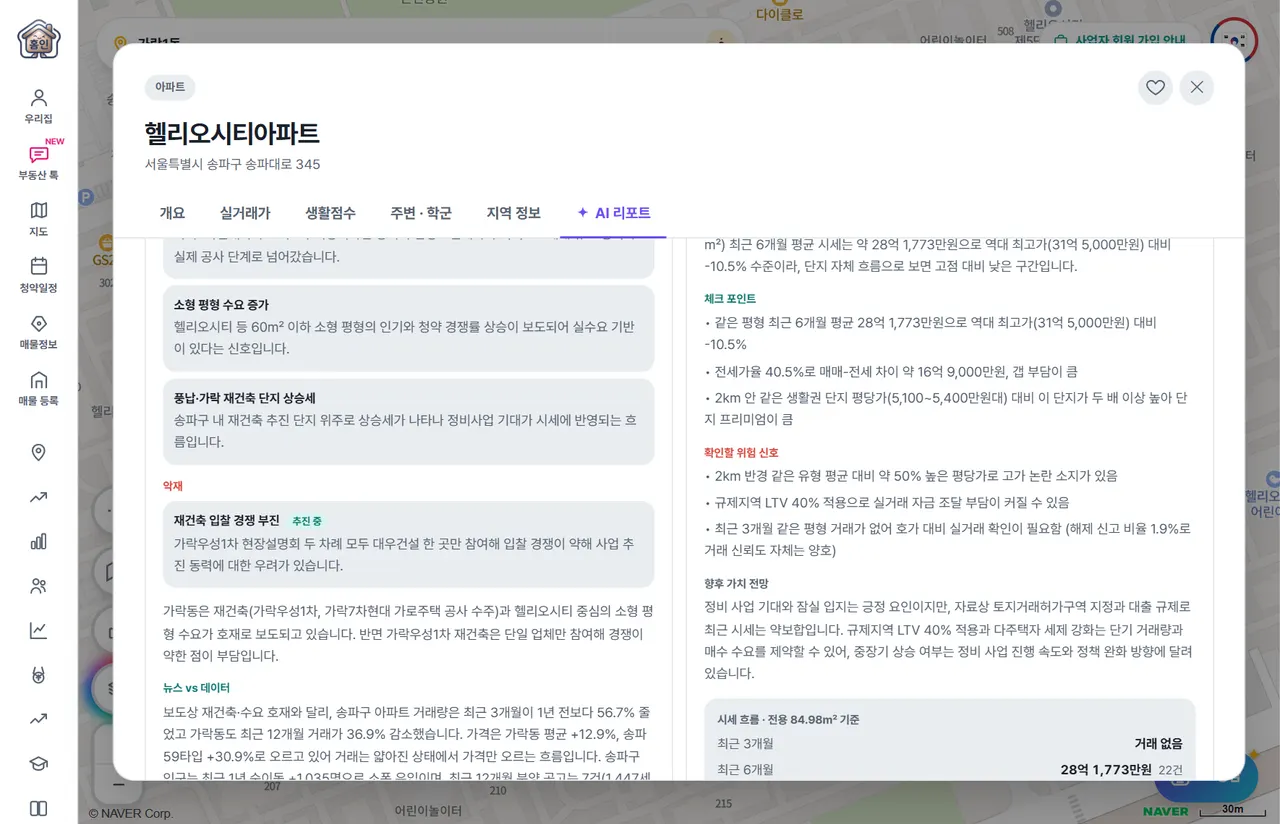
It may take some time to analyze newly opened complexes or older reports. You can check the analysis date next to the item title to see when the content is based.
How is the judgment determined?
The decision for AI purchase analysis is determined by comparing the price per pyeong of the complex with the average of similar complexes within a 2km radius . When there are 5 or more transactions to compare, the following criteria are applied.
- Potential controversy over high price — More than 1.1 times the surrounding average
- Market Price Level — More than 0.95 times the surrounding average, less than 1.1 times
- Margin of safety — 0.95 times or less of the surrounding average
The assessment only shows the price level compared to the surrounding area. It does not take into account factors such as the age of the building or differences in location, so please also examine whether there is a reason why it is more expensive than the surroundings.
How to read numerical items
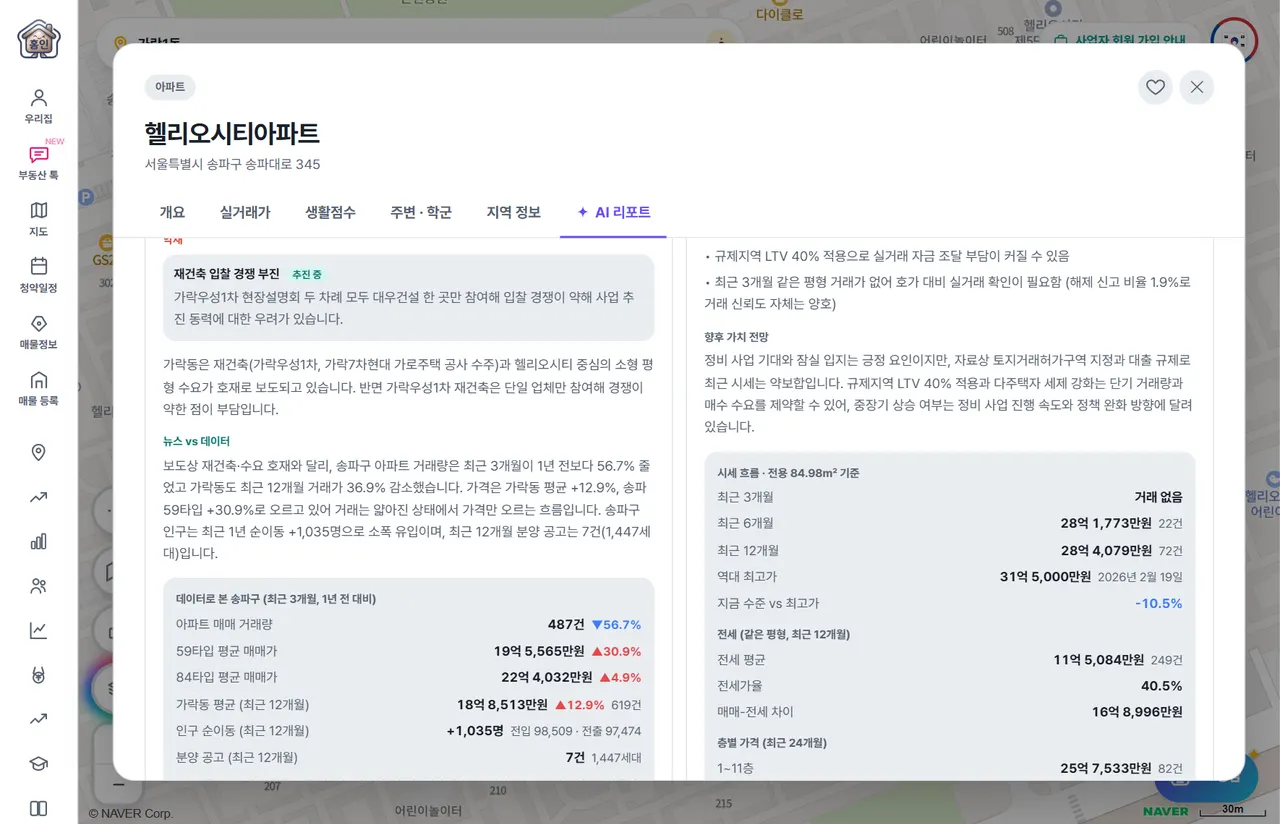
The figures are recalculated daily using real transaction data from the Ministry of Land, Infrastructure and Transport. Transactions reported as cancelled have been subtracted from the market price.
- Market price trends — Compare the recent 3, 6, and 12-month averages with the all-time highs based on the apartment sizes with the most transactions.
- Jeonse — Shows the average Jeonse price for the same size, the Jeonse price ratio, and the difference between sale and Jeonse.
- Prices by Floor — Compare transactions over the past 24 months divided into low, middle, and high floors.
- Similar nearby complexes — this is the price per pyeong of complexes with similar age and number of households within a 2km radius.
- Surrounding Presale Supply — These are presale announcements and scheduled application announcements for the past 12 months within a 2km radius.
- Release Report — This is the percentage of transactions released in the last 12 months.
Checkpoints and danger signals
This is the part that the AI organized into sentences based on the figures.
- Checkpoint — This is the first thing to check when looking at this complex.
- Warning signs to check — points to watch out for, such as prices higher than the surroundings, lending restrictions, and a lack of recent transactions.
- Future Value Outlook — This is an opinion based on a synthesis of local news and market trends. Please view it as an interpretation, not a prediction.
Regional Positive and Negative Factors and News vs. Data
Local Pros and Cons are contents organized by AI analyzing public posts from news, blogs, and online communities. Each item is labeled with a progress stage, such as "Planned," "In Progress," "Under Construction," or "Completed," allowing you to distinguish between news that is still in the planning stage and news that is already in progress.
"News vs. Data " is a section that compares whether the sentiment in the news aligns with actual trading volume, market prices, and population movements. You need to view this with caution if trading is decreasing even when there are many positive news articles. You can gather news from various regions in the "Positive & Negative News" section.
Points to note when using
- Please check the source. Since the positive and negative news are summaries of publicly available posts, they may contain inaccuracies or outdated information.
- Please check the date. Regional analysis is based on the analysis date. News released after the analysis may not be reflected.
- Please make your own judgment. We cannot perform on-site inspections, check the land registry, or verify loan conditions on your behalf.
You can find out how to interpret actual transaction prices directly in "How to Properly Read Apartment Actual Transaction Prices ."
Frequently Asked Questions
Are the numbers in the AI report generated by AI?
No. Figures such as market prices, Jeonse ratios, and prices by floor are calculated directly using public data, and the AI writes sentences based on those figures. However, since the sentences include interpretation, please read them along with the numbers.
When is the regional analysis updated?
For the first 7 days of analysis, it is displayed as is, and after 7 days, it is re-analyzed when there is new news. After 30 days, it is re-analyzed even if there is no new news.
Is it okay to buy if it is within the safety margin range?
No. That assessment is merely a price level compared to the surrounding average and is not investment advice. The reason it is cheaper than the surroundings could be due to the age of the building or the location, so you need to verify it yourself.
Can I see it in all complexes?
You may receive a notice stating that a report cannot be generated for complexes with insufficient data on actual transaction and presale prices.
Related guides
- How to Properly Read Actual Apartment Transaction Prices — From Area and Floor to Transaction Timing
- How to Read Market Trends Using New Highs, New Lows, and Trading Volume Rankings
- Finding an Apartment with Active Trading — How to Read the Transaction Rate Relative to Households and Neighborhood Population Composition